TL;DR MLE agents beat human-engineered SSL baselines in 8 of 12 settings.Program selection remains the bottleneck. We introduce ProgramSelectBench to study it.
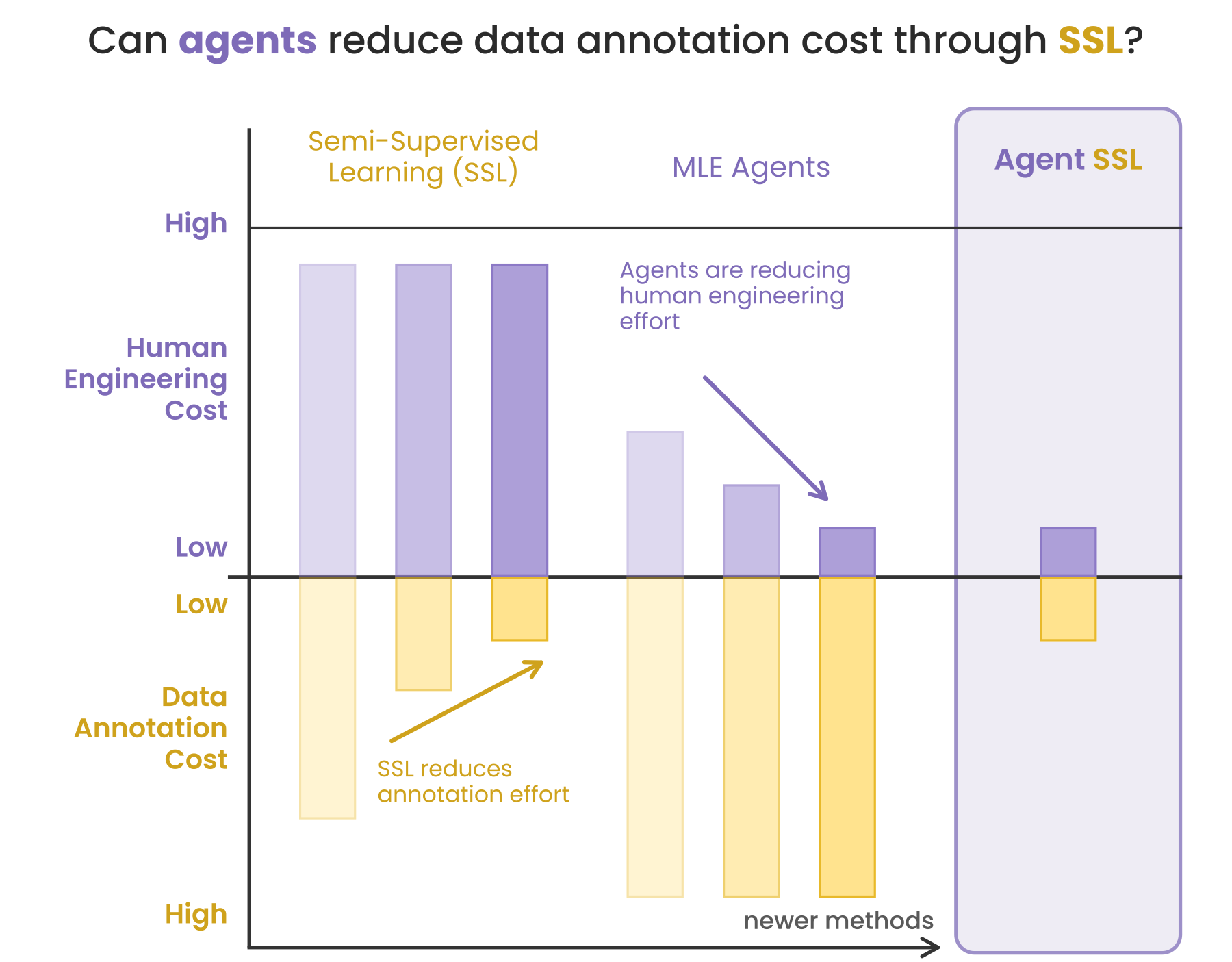
MLE agents reduce engineering cost but rely on labeled data; semi-supervised learning reduces
annotation cost but needs human engineering. We ask whether agents can reduce both, and find they can
discover strong programs that leverage unlabeled data.
Abstract
Applying machine learning systems to new domains introduces bottlenecks in both labeled data
acquisition and manual pipeline engineering. While recent MLE agents show promise in automating
pipeline design, they have been studied almost exclusively in fully supervised settings, leaving
them untested in realistic regimes where labeled data is scarce but unlabeled data is abundant. In
this work, we introduce Agentic Semi-Supervised Learning (AgentSSL), framing SSL as a program
search problem and studying how agents navigate this space under limited supervision. We find that
even under weak feedback and matched compute, agents can synthesize code that combines and adapts
established SSL techniques, exceeding the strongest human-engineered baselines in 8 of 12 settings
by up to +21.8%. However, our results identify program selection as a critical bottleneck in
AgentSSL, where performance drops by as much as 47% when selecting based on the agent's feedback
metric. To systematically study this bottleneck, we introduce ProgramSelectBench, a
large-scale benchmark with a combined total of 16,977 agent-generated and human-engineered SSL
programs, and evaluate both unsupervised and active program selection methods. We further evaluate
AgentSSL on real-world ecology detection tasks, highlighting the opportunities and challenges of
transferring agent-discovered strategies beyond controlled benchmarks.
Contributions
1) AgentSSL: we introduce Agentic Semi-Supervised Learning, formulating SSL as agentic search over the space of learning programs.
2) Strong programs: under weak feedback and matched compute, agents discover SSL programs that outperform established human-engineered baselines in 8 of 12 settings, by up to 21.81 percentage points.
3) Systematic analysis: agents discover diverse, domain-adapted programs that combine established SSL techniques and effectively leverage unlabeled data.
4) ProgramSelectBench: we identify reliable program selection as an open problem and release a benchmark of 16,977 agent-generated and human-engineered programs for unsupervised and active selection.
5) Real-world ecology: we evaluate AgentSSL on animal detection tasks, demonstrating the potential and challenges of reducing annotation and engineering costs in practice.
Method
We frame SSL as a program search problem using LLM-based agents.
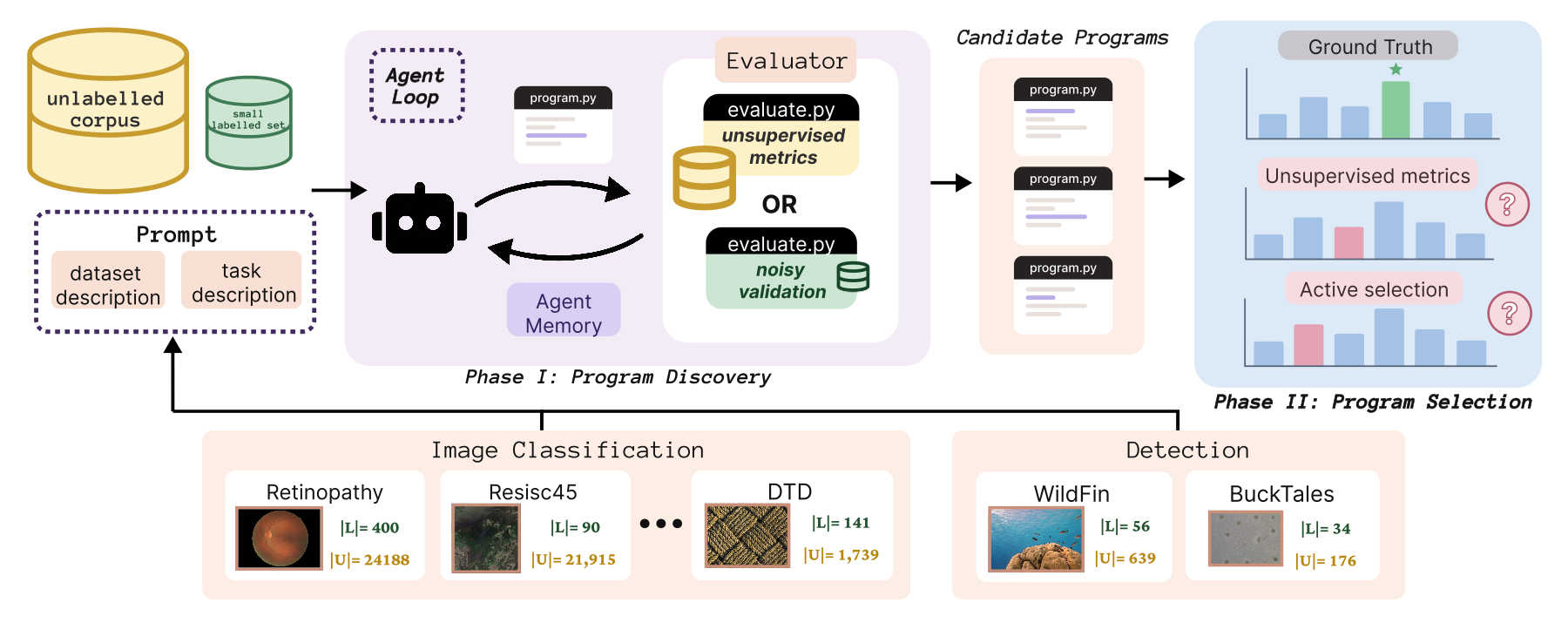
Given a small labeled set and a larger unlabeled corpus, an LLM-based agent writes SSL programs. Each program is
scored by an evaluator using either unsupervised SSL metrics or noisy validation feedback, and that
fitness guides iterative refinement (program discovery). From the candidate pool, a program must then be
selected using label-free metrics or active model selection that queries a limited number of test labels
(program selection).
We evaluate AgentSSL on six image-classification SSL benchmarks (DTD, SUN397, RESISC45, Retinopathy, CLEVR,
KITTI) and two real-world ecological detection tasks (WildFin, BuckTales). Classification experiments use
CLIP ViT-B-16 and DINOv2-B backbones, three random data splits per setting, and compute budgets matched to
baseline costs: 8 hours for DTD, RESISC45, and KITTI; 15 hours for SUN397, Retinopathy, and CLEVR.
Results
Can agents beat human-engineered SSL?
Across datasets and shot settings, the best agent solution
(Abest) is generally comparable to the best
human-engineered SSL baseline (Hbest), and
outperforms it in 8 of 12 settings, by up to +21.81 percentage points on Retinopathy,
even when search feedback is weakly or negatively correlated with test accuracy.
Feedback:
Hover a cell to trace its column.
DTD
SUN397
RESISC45
RETINO
CLEVR
KITTI
Method
3
6
3
6
1
2
40
80
10
20
5
10
Supervised
61.47
70.23
63.35
70.54
55.71
70.98
50.66
51.48
39.96
46.62
41.54
45.66
FixMatch
60.71
70.12
63.10
70.90
62.13
81.60
34.93
39.70
38.93
56.32
39.05
42.76
SoftMatch
62.59
69.80
69.68
73.29
73.17
86.04
44.14
54.37
46.48
66.83
40.04
41.30
FineSSL
65.83
73.00
68.41
72.33
76.13
86.93
27.47
27.43
34.21
47.54
40.74
37.22
PET
65.43
71.97
63.94
68.19
60.48
78.31
30.45
32.77
33.34
34.31
39.01
42.80
V-PET
66.03
72.87
66.87
71.92
60.94
76.99
24.12
29.13
38.07
35.17
39.29
41.02
AgentSSLN
65.50
72.38
69.14
70.90
–
79.82
72.47
73.47
51.57
52.92
48.52
50.21
AgentSSLU
68.94
73.76
68.46
72.36
79.80
80.98
50.73
49.65
43.43
52.81
49.74
53.45
Abest − Hbest
+2.91
+0.76
−0.54
−0.93
+3.67
−5.95
+21.81
+19.10
+5.09
−13.92
+8.20
+7.78
Oracle test accuracy (%) by dataset and labels per class. Each program is evaluated on all three data splits;
the best program is selected by its average test accuracy across splits. Best human-engineered SSL
baseline per column in purple, best agent result in
gold. U: unsupervised-metric feedback;
N: noisy-validation feedback. A dash marks the unavailable 1-shot noisy-validation setting.
Abest − Hbest compares the best agent under the selected feedback filter with the best human baseline.
Both shows the paper’s reported differences; individual feedback views recompute them from the displayed, rounded accuracies.
Can we reliably select the best program?
Discovering a strong program is only part of the challenge. Selecting with weak feedback can lose up to
47.29 percentage points relative to oracle selection. When feedback aligns with test accuracy,
much of the oracle performance is retained; when it does not, selection can fail substantially.
DTD
SUN397
RESISC45
RETINO
CLEVR
KITTI
Method
3
6
3
6
1
2
40
80
10
20
5
10
Humanall
−3.39
−2.87
−4.69
−1.69
−14.63
−1.93
−23.92
−42.66
−15.59
−20.28
−9.10
−17.53
AgentSSLN
−0.67
−2.34
−0.13
−0.13
–
−10.38
−38.12
−47.29
0.00
−2.66
−8.20
−19.83
AgentSSLU
−3.81
−10.74
−1.90
−3.60
−14.43
−2.25
−24.12
−18.62
−13.56
−3.23
−10.50
−20.96
Table 2. Selection regret averaged across seeds, shown as the change in accuracy from oracle selection
(percentage points; closer to zero is better). Humanall selects across all human algorithms and
hyperparameters using the rank metric; agent rows select programs within a single trajectory using
their feedback metric. N: noisy validation; U: unsupervised metrics.
Darker red indicates a larger loss. A dash marks the unavailable 1-shot noisy-validation setting.
Can active model selection help?
When unsupervised metrics fail, spending labels on program selection can be more valuable than
spending them all on training. Under a fixed label budget, splitting labels evenly between training and
selection yields gains of up to 26.07 percentage points on Retinopathy and 14.63 on KITTI,
but costs accuracy on datasets where unsupervised selection already works.
Method
DTD
SUN397
RESISC45
RETINO
CLEVR
KITTI
ActiveTesting
−2.35
−1.17
−2.61
+25.59
−5.41
+10.46
VMA
−1.86
−1.47
−7.68
+26.07
−4.49
+14.43
CODA
−2.50
−2.09
−0.87
+21.22
−29.09
+14.63
IID
−4.71
−0.83
−3.47
+26.07
−5.75
+10.01
ModelSelector
−2.32
−0.87
−13.21
+18.70
−2.05
+0.00
Table 3. Change in final selection accuracy (percentage points) on AgentSSL unsupervised-feedback runs:
50% of labels for training / 50% for active selection minus 100% for training / 0% for unsupervised selection.
Green indicates an improvement; red indicates a loss. IID, ActiveTesting, VMA, and ModelSelector are averaged
over 10 active-selection runs; CODA is deterministic.
Reliable program selection remains the bottleneck: selecting with the agent’s feedback metric
can lose up to 47.29 percentage points relative to oracle selection.
ProgramSelectBench provides
16,977 evaluated program instances across 35 tasks, representing over 10,000 GPU hours,
to study selection independently of program discovery. Splitting the label budget evenly between training
and active selection improves accuracy where unsupervised metrics fail, but costs accuracy where they
already work.
Analysis
Do agents actually use unlabeled data?
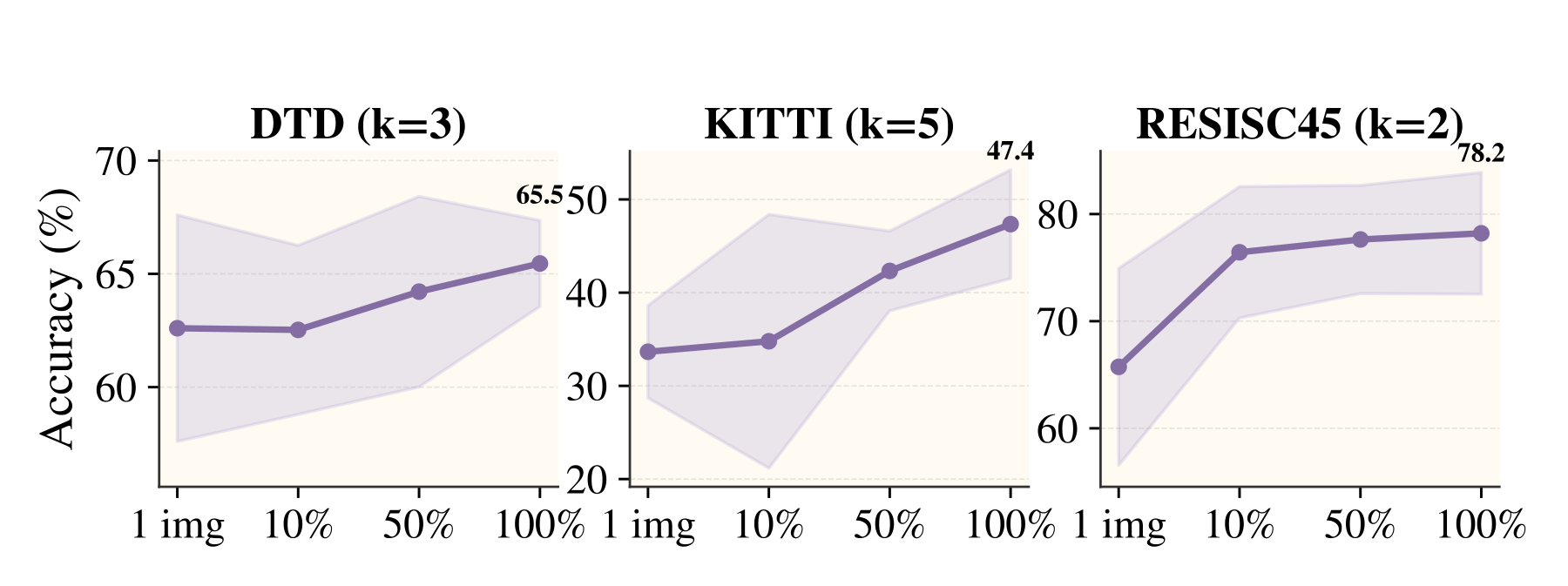
We fix the top program discovered by AgentSSL and vary only the size of the unlabeled corpus at
evaluation time. Performance generally improves as more unlabeled data becomes available while the labeled
set stays fixed, so the discovered programs rely on structure in the unlabeled data itself.
How do agents use unlabeled data?
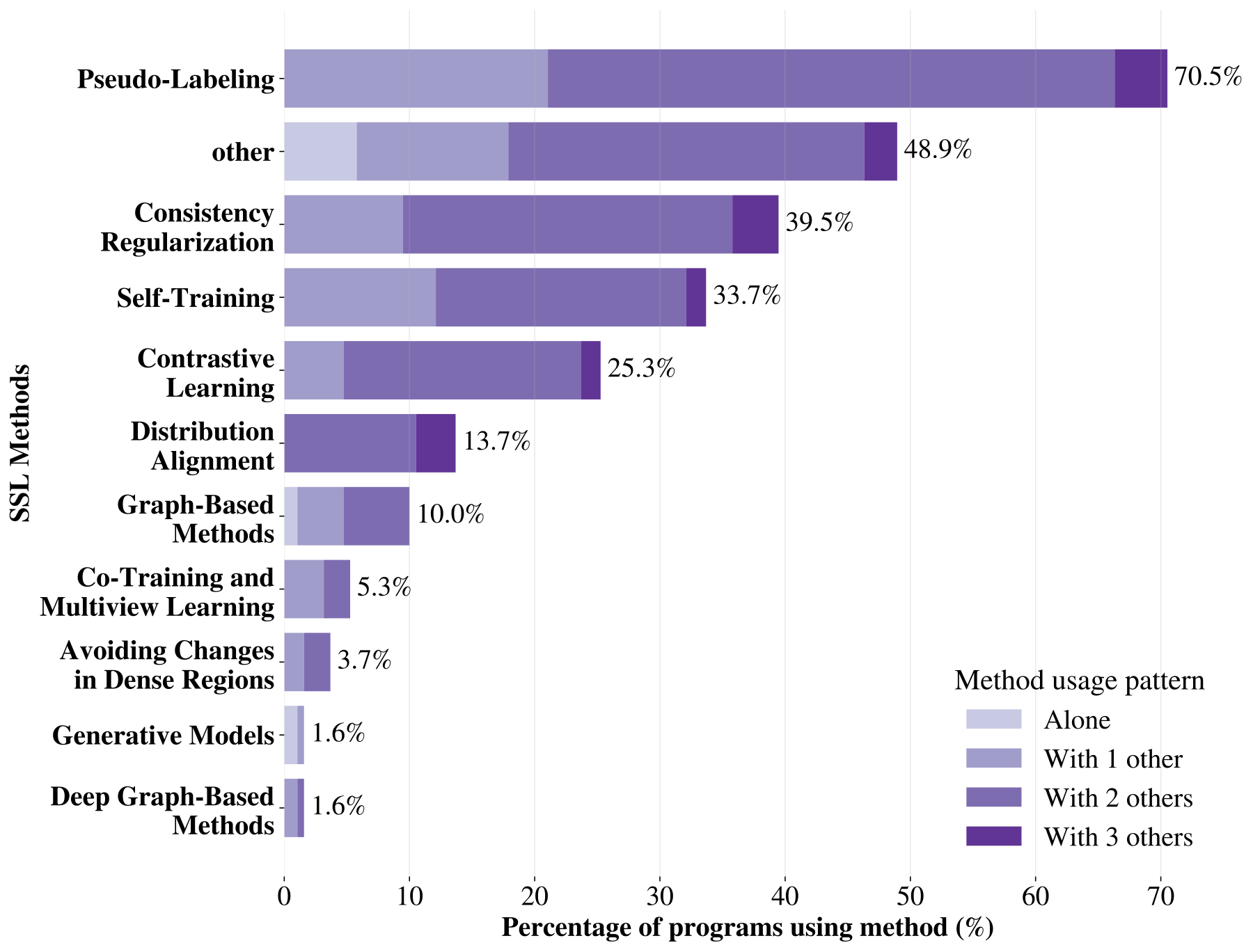
Rather than converging to a single method family, agents explore a broad range of SSL paradigms, from
pseudo-labeling and consistency regularization to graph-based methods, and often combine several within
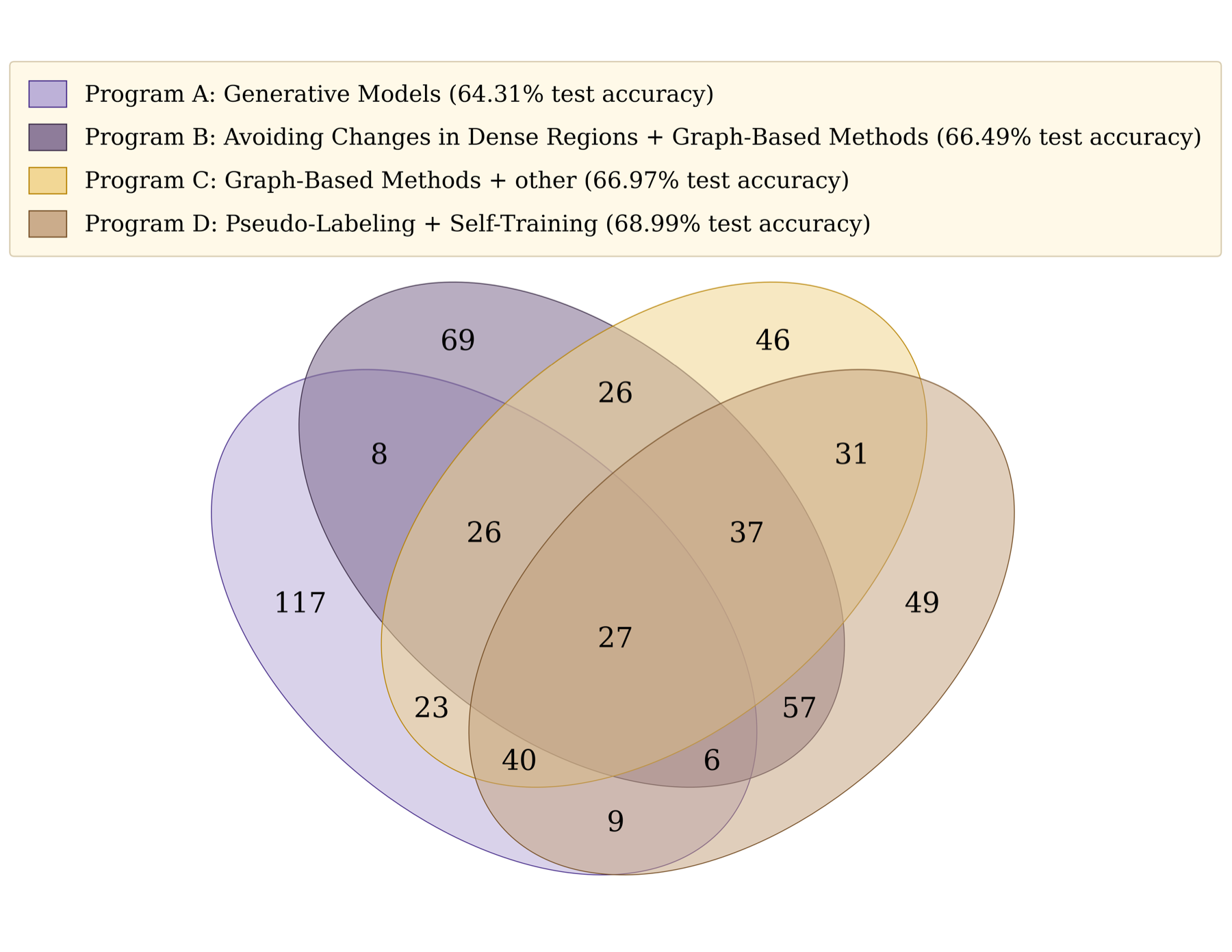
one program. The resulting programs are also complementary: high-performing programs built on different SSL
strategies confidently pseudolabel different subsets of the unlabeled images.
SSL method families explored across all rollouts on DTD (evolutionary search).
Overlap of each program's top-20% most confident pseudolabels on unlabeled DTD.
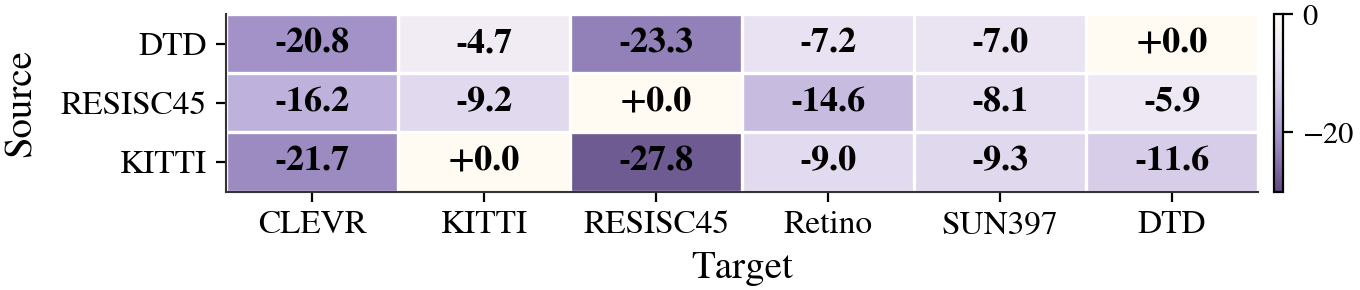
Are programs tailored to their domain?
Agents can discover dataset-specific strategies instead of relying on one fixed SSL recipe. The best
programs discovered for one dataset often transfer poorly to others, evidence that they are adapted to their source domain.
Change in accuracy relative to in-domain performance (rows: source dataset; columns: target).
On Retinopathy, the best program trains no classifier at all. It uses frozen DINOv2 features,
nearest-neighbor evidence, class prototypes and an explicit ordinal bias, matching the fact that labels
are ordered disease-severity levels. In the 80-labels-per-class setting, it beats the next-best baseline by 19.10 percentage points.
Read the agent-written Retinopathy program (484 lines of Python)
Frozen DINOv2 features · label propagation · class prototypes · ordinal severity bias · test-time augmentationDownload .py
from __future__ import annotations
import json
import os
from typing import List, Tuple

import torch
import torch.nn.functional as F
from torch.utils.data import Dataset, DataLoader
import torchvision.transforms as T
from PIL import Image


def _read_json(path: str):
    with open(path, "r") as f:
        return json.load(f)


def _coco_label_mapping(train_ann_file: str):
    coco = _read_json(train_ann_file)
    cat_ids = sorted(c["id"] for c in coco["categories"])
    cat_id_to_idx = {cid: i for i, cid in enumerate(cat_ids)}
    idx_to_cat_id = {i: cid for cid, i in cat_id_to_idx.items()}
    return cat_id_to_idx, idx_to_cat_id, len(cat_ids)


def _labeled_records(img_dir: str, train_ann_file: str, cat_id_to_idx: dict):
    coco = _read_json(train_ann_file)
    id_to_name = {img["id"]: img["file_name"] for img in coco["images"]}
    out = []
    for ann in coco["annotations"]:
        fn = id_to_name.get(ann["image_id"])
        if fn is None:
            continue
        path = os.path.join(img_dir, fn)
        if not os.path.isfile(path):
            continue
        cid = ann["category_id"]
        if cid not in cat_id_to_idx:
            continue
        out.append((path, cat_id_to_idx[cid]))
    return out


def _unlabeled_records(img_dir: str, unlabel_ann_file: str):
    coco = _read_json(unlabel_ann_file)
    out = []
    for img in coco["images"]:
        fn = img["file_name"]
        path = os.path.join(img_dir, fn)
        if os.path.isfile(path):
            out.append(path)
    return out


class _ImageOnlyDataset(Dataset):
    def __init__(self, paths, transform):
        self.paths = paths
        self.transform = transform

    def __len__(self):
        return len(self.paths)

    def __getitem__(self, idx):
        img = Image.open(self.paths[idx]).convert("RGB")
        return self.transform(img)


class _GraphConfig:
    def __init__(
        self,
        k_ul: int = 24,
        k_uu: int = 24,
        temperature: float = 0.07,
        alpha: float = 0.85,
        iters: int = 25,
        chunk_q: int = 1024,
    ):
        self.k_ul = k_ul
        self.k_uu = k_uu
        self.temperature = temperature
        self.alpha = alpha
        self.iters = iters
        self.chunk_q = chunk_q


class ClassificationAgent:
    NET_NAME = "timm/vit_base_patch14_reg4_dinov2.lvd142m"

    def __init__(self, net_builder_fn, get_peft_config_fn, num_classes):
        self.net_builder_fn = net_builder_fn
        self.get_peft_config_fn = get_peft_config_fn
        self.num_classes = num_classes
        self.device = torch.device("cuda" if torch.cuda.is_available() else "cpu")

        self.img_size = 224
        self.transform = self._eval_transform(self.img_size)
        self.idx_to_cat_id = {i: i for i in range(num_classes)}

        peft_config = self.get_peft_config_fn({"freeze_backbone": True})
        vit_config = {"drop_path_rate": 0.0}
        net_builder = self.net_builder_fn(self.NET_NAME, peft_config, vit_config)
        self.model = net_builder(
            num_classes=num_classes, pretrained=True, pretrained_path=""
        ).to(self.device)
        self.model.eval()

        self.graph_cfg = _GraphConfig()

        self.train_feat = None
        self.train_labels = None
        self.train_prop = None
        self.class_prototypes = None
        self.residual_quantiles = None

        self.k_query = 32
        self.k_proto = 5
        self.tta_shift = 8

        self.fuse_w_knn_hard = 1.15
        self.fuse_w_knn_prop = 0.85
        self.fuse_w_proto = 0.55
        self.fuse_w_ord = 0.30
        self.score_temp = 0.07
        self.proto_temp = 0.09
        self.conformal_q = 0.80

    def _eval_transform(self, img_size=224):
        resize = int(img_size * 256 / 224)
        return T.Compose(
            [
                T.Resize(resize, interpolation=T.InterpolationMode.BICUBIC),
                T.CenterCrop(img_size),
                T.ToTensor(),
                T.Normalize(
                    mean=[0.485, 0.456, 0.406],
                    std=[0.229, 0.224, 0.225],
                ),
            ]
        )

    @torch.no_grad()
    def _extract_features(self, paths, batch_size=64):
        if len(paths) == 0:
            return torch.empty((0, 768), dtype=torch.float32)

        ds = _ImageOnlyDataset(paths, self.transform)
        loader = DataLoader(
            ds,
            batch_size=min(batch_size, max(1, len(ds))),
            shuffle=False,
            num_workers=min(8, os.cpu_count() or 0),
            pin_memory=self.device.type == "cuda",
            drop_last=False,
        )

        feats = []
        for x in loader:
            x = x.to(self.device, non_blocking=True)
            out = self.model(x)
            feats.append(out["feat"].detach().cpu())
        if len(feats) == 0:
            return torch.empty((0, 768), dtype=torch.float32)
        return torch.cat(feats, dim=0)

    def _build_sparse_neighbors(self, xu: torch.Tensor, xl: torch.Tensor):
        cfg = self.graph_cfg
        device = self.device
        xu = xu.to(device)
        xl = xl.to(device)

        Nu = xu.shape[0]
        Nl = xl.shape[0]
        if Nu == 0 or Nl == 0:
            raise RuntimeError(
                "Neighbor graph requires both labeled and unlabeled features."
            )

        k_ul = min(cfg.k_ul, Nl)
        k_uu = min(cfg.k_uu + 1, Nu)

        ul_idx_parts, ul_w_parts = [], []
        uu_idx_parts, uu_w_parts = [], []

        for start in range(0, Nu, cfg.chunk_q):
            end = min(start + cfg.chunk_q, Nu)
            q = xu[start:end]

            sim_ul = q @ xl.T
            vals_ul, idx_ul = torch.topk(sim_ul, k=max(1, k_ul), dim=1)
            w_ul = torch.softmax(vals_ul / cfg.temperature, dim=1)
            ul_idx_parts.append(idx_ul.cpu())
            ul_w_parts.append(w_ul.cpu())

            if Nu == 1:
                idx_uu = torch.zeros((end - start, 1), dtype=torch.long, device=device)
                vals_uu = torch.zeros(
                    (end - start, 1), dtype=torch.float32, device=device
                )
            else:
                sim_uu = q @ xu.T
                vals_uu, idx_uu = torch.topk(sim_uu, k=max(2, k_uu), dim=1)
                rows = torch.arange(start, end, device=device).unsqueeze(1)
                keep = idx_uu != rows
                idx_uu = idx_uu[keep].view(end - start, -1)
                vals_uu = vals_uu[keep].view(end - start, -1)
                if idx_uu.shape[1] == 0:
                    idx_uu = torch.zeros(
                        (end - start, 1), dtype=torch.long, device=device
                    )
                    vals_uu = torch.zeros(
                        (end - start, 1), dtype=torch.float32, device=device
                    )
                else:
                    idx_uu = idx_uu[:, : min(cfg.k_uu, idx_uu.shape[1])]
                    vals_uu = vals_uu[:, : min(cfg.k_uu, vals_uu.shape[1])]

            w_uu = torch.softmax(vals_uu / cfg.temperature, dim=1)
            uu_idx_parts.append(idx_uu.cpu())
            uu_w_parts.append(w_uu.cpu())

        ul_idx = torch.cat(ul_idx_parts, dim=0)
        ul_w = torch.cat(ul_w_parts, dim=0)
        uu_idx = torch.cat(uu_idx_parts, dim=0)
        uu_w = torch.cat(uu_w_parts, dim=0)
        return ul_idx, ul_w, uu_idx, uu_w

    def _label_propagation(self, xl: torch.Tensor, yl: torch.Tensor, xu: torch.Tensor):
        num_classes = self.num_classes
        cfg = self.graph_cfg

        xl = F.normalize(xl.float(), dim=1)
        xu = F.normalize(xu.float(), dim=1)

        y_onehot = F.one_hot(yl, num_classes=num_classes).float()
        ul_idx, ul_w, uu_idx, uu_w = self._build_sparse_neighbors(xu, xl)

        yu = torch.full(
            (xu.shape[0], num_classes), 1.0 / num_classes, dtype=torch.float32
        )

        for _ in range(cfg.iters):
            msg_l = torch.sum(ul_w.unsqueeze(-1) * y_onehot[ul_idx], dim=1)
            msg_u = torch.sum(uu_w.unsqueeze(-1) * yu[uu_idx], dim=1)
            yu = (1.0 - cfg.alpha) * msg_l + cfg.alpha * msg_u
            yu = yu / yu.sum(dim=1, keepdim=True).clamp_min(1e-8)

        return y_onehot, yu

    def _compute_train_propagated_probs(
        self, xl: torch.Tensor, yl: torch.Tensor, xu: torch.Tensor, yu: torch.Tensor
    ):
        xl_n = F.normalize(xl.float(), dim=1)
        xu_n = F.normalize(xu.float(), dim=1)
        y_onehot = F.one_hot(yl, num_classes=self.num_classes).float()

        sims_ll = xl_n @ xl_n.T
        sims_lu = xl_n @ xu_n.T

        if xl.shape[0] <= 1:
            msg_ll = y_onehot.clone()
        else:
            k_ll = min(16, xl.shape[0] - 1)
            vals_ll, idx_ll = torch.topk(
                sims_ll, k=min(k_ll + 1, sims_ll.shape[1]), dim=1
            )
            rows = torch.arange(xl.shape[0]).unsqueeze(1)
            keep = idx_ll != rows
            idx_ll = idx_ll[keep].view(xl.shape[0], -1)[:, :k_ll]
            vals_ll = vals_ll[keep].view(xl.shape[0], -1)[:, :k_ll]
            w_ll = torch.softmax(vals_ll / 0.07, dim=1)
            msg_ll = torch.sum(w_ll.unsqueeze(-1) * y_onehot[idx_ll], dim=1)

        if xu.shape[0] == 0:
            msg_lu = torch.full_like(msg_ll, 1.0 / self.num_classes)
        else:
            k_lu = min(32, xu.shape[0])
            vals_lu, idx_lu = torch.topk(sims_lu, k=k_lu, dim=1)
            w_lu = torch.softmax(vals_lu / 0.07, dim=1)
            msg_lu = torch.sum(w_lu.unsqueeze(-1) * yu[idx_lu], dim=1)

        prop = 0.6 * msg_ll + 0.4 * msg_lu
        prop = prop / prop.sum(dim=1, keepdim=True).clamp_min(1e-8)
        return prop

    def _build_prototypes(self, xl: torch.Tensor, yl: torch.Tensor):
        protos = []
        for c in range(self.num_classes):
            mask = yl == c
            if mask.any():
                proto = xl[mask].mean(dim=0)
            else:
                proto = xl.mean(dim=0)
            protos.append(F.normalize(proto, dim=0))
        return torch.stack(protos, dim=0)

    def _fused_local_logits(
        self,
        query_feat: torch.Tensor,
        leave_one_out_index: int | None = None,
    ):
        feat = F.normalize(query_feat.float(), dim=1).cpu()
        train_feat = self.train_feat
        train_labels = self.train_labels
        train_prop = self.train_prop
        prototypes = self.class_prototypes
        num_classes = self.num_classes

        sim = feat @ train_feat.T

        if leave_one_out_index is not None and feat.shape[0] == 1:
            sim[:, leave_one_out_index] = -1e4

        k = min(
            self.k_query,
            train_feat.shape[0] - (1 if leave_one_out_index is not None else 0),
        )
        k = max(1, k)

        vals, idx = torch.topk(sim, k=k, dim=1)
        w = torch.softmax(vals / self.score_temp, dim=1)

        neigh_labels = train_labels[idx]
        hard = F.one_hot(neigh_labels, num_classes=num_classes).float()
        hard_prob = torch.sum(w.unsqueeze(-1) * hard, dim=1)

        prop_prob = torch.sum(w.unsqueeze(-1) * train_prop[idx], dim=1)
        prop_prob = prop_prob / prop_prob.sum(dim=1, keepdim=True).clamp_min(1e-8)

        sim_proto = feat @ prototypes.T
        proto_prob = torch.softmax(sim_proto / self.proto_temp, dim=1)

        class_vals = torch.arange(num_classes, dtype=feat.dtype).unsqueeze(0)
        exp_severity = torch.sum(hard_prob * class_vals, dim=1, keepdim=True)
        ord_bias = -torch.abs(class_vals - exp_severity)

        fused = (
            self.fuse_w_knn_hard * torch.log(hard_prob.clamp_min(1e-8))
            + self.fuse_w_knn_prop * torch.log(prop_prob.clamp_min(1e-8))
            + self.fuse_w_proto * torch.log(proto_prob.clamp_min(1e-8))
            + self.fuse_w_ord * ord_bias
        )
        return fused

    def _build_conformal_residuals(self):
        n = self.train_feat.shape[0]
        residuals = []
        correct = 0
        for i in range(n):
            logits_i = self._fused_local_logits(
                self.train_feat[i : i + 1], leave_one_out_index=i
            )
            probs_i = torch.softmax(logits_i, dim=-1).squeeze(0)
            true_y = int(self.train_labels[i].item())
            true_prob = probs_i[true_y].item()
            residuals.append(1.0 - true_prob)
            if int(torch.argmax(probs_i).item()) == true_y:
                correct += 1

        residuals = torch.tensor(residuals, dtype=torch.float32)
        q = torch.quantile(residuals, self.conformal_q).item()
        self.residual_quantiles = torch.full(
            (self.num_classes,), float(q), dtype=torch.float32
        )
        print(
            f"local_loo_acc={correct / max(n, 1):.4f} "
            f"conformal_q={self.conformal_q:.2f} "
            f"resid_quantile={q:.4f}",
            flush=True,
        )

    def fit(self, img_dir, train_ann_file, unlabel_ann_file):
        cat_id_to_idx, idx_to_cat_id, num_classes = _coco_label_mapping(train_ann_file)
        self.idx_to_cat_id = idx_to_cat_id
        self.num_classes = num_classes

        labeled = _labeled_records(img_dir, train_ann_file, cat_id_to_idx)
        unlabeled = _unlabeled_records(img_dir, unlabel_ann_file)

        if len(labeled) == 0:
            raise RuntimeError("No labeled samples found.")
        if len(unlabeled) == 0:
            raise RuntimeError("No unlabeled samples found.")

        labeled_paths = [p for p, _ in labeled]
        yl = torch.tensor([y for _, y in labeled], dtype=torch.long)

        print(
            f"extract_features labeled={len(labeled_paths)} unlabeled={len(unlabeled)}",
            flush=True,
        )
        xl = self._extract_features(labeled_paths, batch_size=64)
        xu = self._extract_features(unlabeled, batch_size=64)

        xl = F.normalize(xl.float(), dim=1)
        xu = F.normalize(xu.float(), dim=1)

        print("running_label_propagation", flush=True)
        _, yu = self._label_propagation(xl, yl, xu)
        prop_l = self._compute_train_propagated_probs(xl, yl, xu, yu)

        self.train_feat = xl.cpu()
        self.train_labels = yl.cpu()
        self.train_prop = prop_l.cpu()
        self.class_prototypes = self._build_prototypes(
            self.train_feat, self.train_labels
        ).cpu()

        print("building_local_conformal_calibration", flush=True)
        self._build_conformal_residuals()

        with torch.no_grad():
            train_logits = self._fused_local_logits(self.train_feat)
            train_probs = torch.softmax(train_logits, dim=-1)
            train_pred = train_probs.argmax(dim=-1)
            acc = (train_pred == self.train_labels).float().mean().item()
            nll = F.nll_loss(
                torch.log(train_probs.clamp_min(1e-8)), self.train_labels
            ).item()
            print(f"fit_train_acc={acc:.4f} fit_train_nll={nll:.4f}", flush=True)

        self.model.eval()
        print("fit_done", flush=True)

    def _tta_views(self, x: torch.Tensor):
        views = [x]
        views.append(torch.flip(x, dims=[3]))
        s = min(self.tta_shift, x.shape[-1] // 16)
        if s > 0:
            views.append(torch.roll(x, shifts=-s, dims=3))
            views.append(torch.roll(x, shifts=s, dims=3))
        return views

    @torch.no_grad()
    def _predict_from_feat(self, feat: torch.Tensor):
        raw_logits = self._fused_local_logits(feat).to(self.device)
        probs = torch.softmax(raw_logits, dim=-1)

        penalty = self.residual_quantiles.to(self.device).unsqueeze(0)
        calibrated_probs = (probs - penalty).clamp_min(1e-8)
        calibrated_probs = calibrated_probs / calibrated_probs.sum(
            dim=1, keepdim=True
        ).clamp_min(1e-8)
        calibrated_logits = torch.log(calibrated_probs.clamp_min(1e-8))
        return calibrated_logits

    @torch.no_grad()
    def predict(self, image_batch):
        self.model.eval()

        if (
            self.train_feat is None
            or self.train_prop is None
            or self.residual_quantiles is None
        ):
            raise RuntimeError("Call fit() before predict().")

        if isinstance(image_batch, torch.Tensor):
            x = image_batch
            if x.ndim == 3:
                x = x.unsqueeze(0)
            x = x.float().to(self.device, non_blocking=True)
        elif isinstance(image_batch, list):
            x = torch.stack(
                [self.transform(im.convert("RGB")) for im in image_batch], dim=0
            ).to(self.device, non_blocking=True)
        else:
            raise TypeError("image_batch must be a Tensor or list of PIL images")

        views = self._tta_views(x)
        logits_sum = None
        feat_main = None

        for i, xv in enumerate(views):
            out = self.model(xv)
            feat = F.normalize(out["feat"].float(), dim=1)
            if i == 0:
                feat_main = feat
            logits_v = self._predict_from_feat(feat)
            logits_sum = logits_v if logits_sum is None else (logits_sum + logits_v)

        logits = logits_sum / float(len(views))
        pred_idx = logits.argmax(dim=-1).detach().cpu().tolist()
        predictions = [{"category_id": int(self.idx_to_cat_id[i])} for i in pred_idx]
        return logits, feat_main, predictions
Real-world ecology
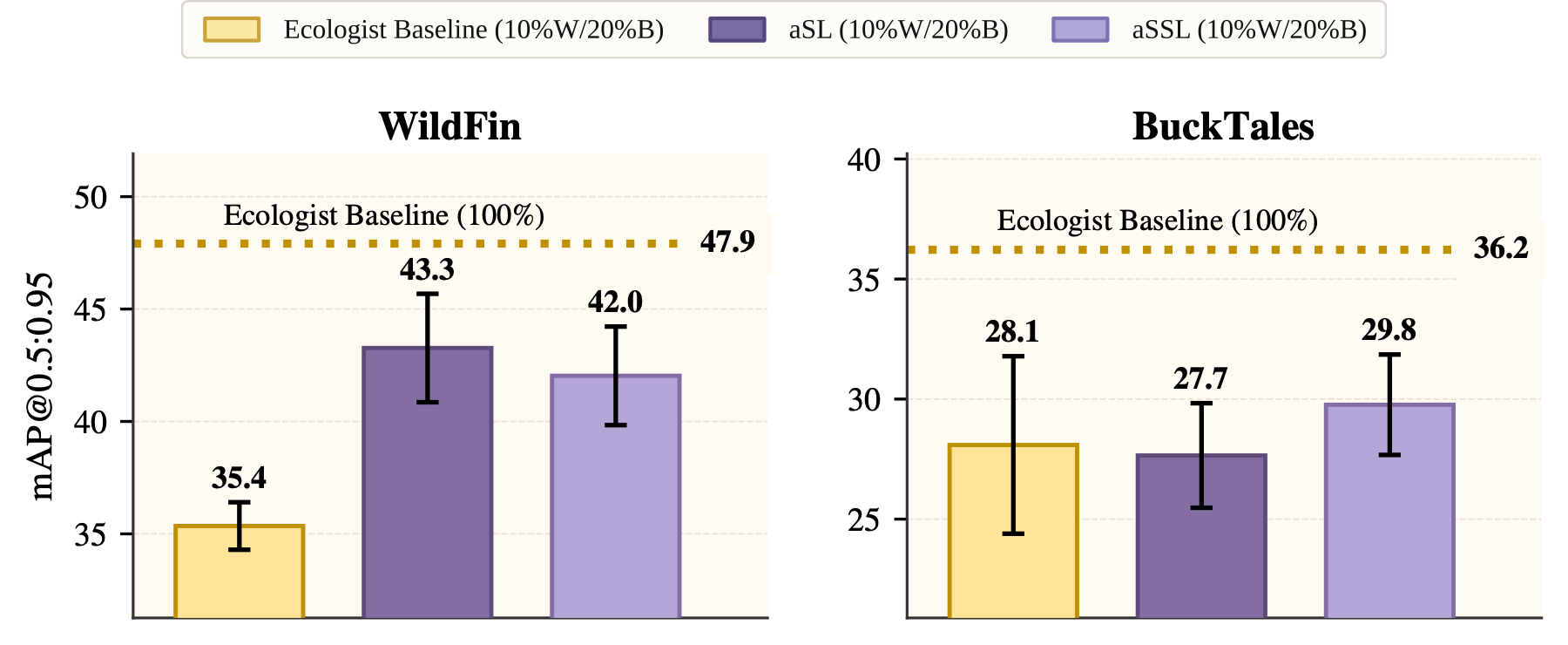
We evaluate AgentSSL on animal detection from two ecological pipelines, WildFin (fish) and
BuckTales (antelope). Agents use only 10% of the labeled training data on WildFin and
20% on BuckTales. We compare AgentSSL, supervised-only AgentSL, and expert pipelines
trained on either the same labeled subset or the full training split.
On WildFin, AgentSL and AgentSSL outperform the low-label expert baseline and approach the full-data
expert pipeline. On BuckTales, both match the low-label baseline but show high variance and underperform
the full-data expert YOLOv8 baseline. Their similar performance suggests that strong supervised design
choices can be as valuable as unlabeled data; future agents should explore both.
BibTeX
@misc{lin2026agentsslmleagentsleverage,
  title={AgentSSL: Can MLE Agents Leverage Unlabeled Data?},
  author={Ethan Lin and Akanksha Sarkar and Ziang Liu and Kristin Branson and Jennifer J. Sun},
  year={2026},
  eprint={2611.17323},
  archivePrefix={arXiv},
  primaryClass={cs.AI},
  url={https://arxiv.org/abs/2611.17323},
}